Oh, Music, How You Move Me!
Have you ever watched a director’s cut of a movie? It often lacks a musical score. The director talks over the film, explaining each scene’s aim. It’s easy to get distracted. Without the music, you miss the story’s intentional hook.
On the flip side, have you been caught up in the moment during a very emotional scene in a movie? Maybe you noticed the music, but most likely, you were just immersed in the moment. Sometimes everything is said through the musical score—no words are spoken, just a glance from across the room paired with the right strings to evoke emotion. An opening montage, with scenes strung together by a masterfully designed piece of music, can share a story’s backstory without adding too much to the movie’s length.
Music sparks emotion, involuntary dancing, head bobbing, and foot tapping. Music cues what is going to happen next; the absence of sound altogether usually signals a jump scare or prompts an increased heart rate. Some music can take us on a journey; it can make us want to dance. It can bring up memories, tears, joy, even pain and sadness. Music moves the soul and sparks creative surges in mind and body.
I reflect on music’s creative power when I imagine C.S. Lewis’s scene in The Magician’s Nephew. Characters find Aslan singing a new world into existence: stars, sun, land, and living creatures arising from his song.
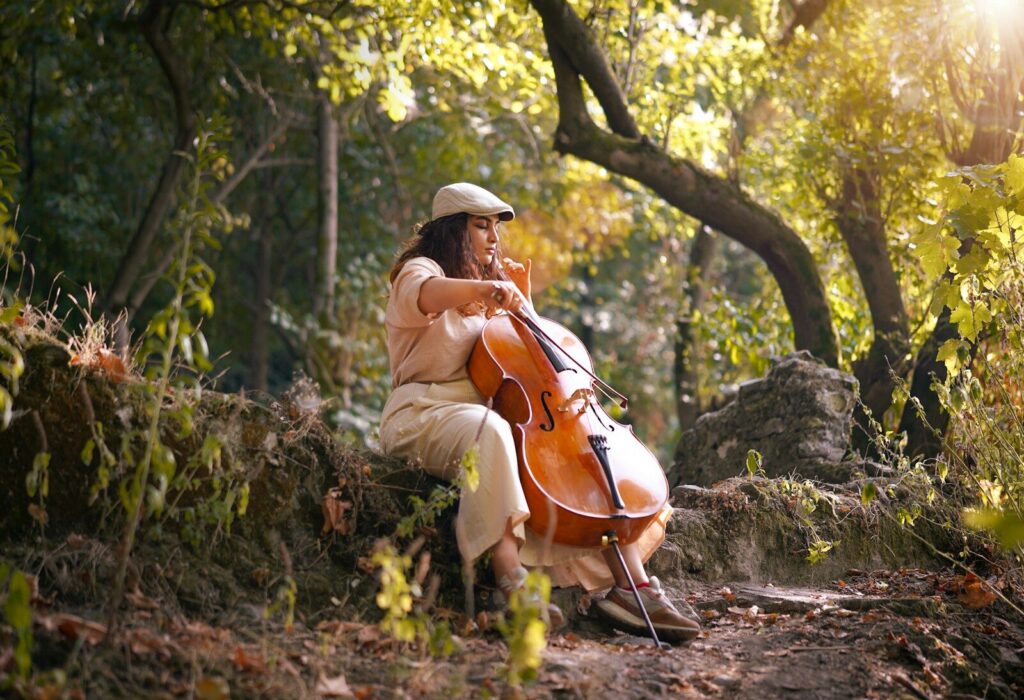
Full disclosure, I am not a musician. However, I do live with one. My daughter is a cellist who has an ear for picking out her part in a piece of music. When we’re watching or listening to something, she’ll say, “Hear that cello part?” I wasn’t able to distinguish the parts at first, but with practice, she’s trained me to listen for it. Pops orchestra is one of her favorites, and I watch as my daughter gets giddy when she hears a beautifully written piece of sheet music. I have observed her body as she goes on and on, delighting in the struggle and joy of learning the music, then finally in the satisfaction of how it sounds when it all comes together. I can appreciate the beautifully performed musical score, but my daughter embodies it, as it flows through her and outward toward those of us lucky enough to be present.
Why am I sharing all this with you?
Recently, I was contemplating trinitarian theology and the notion of how each person of the Trinity is personified: Father, Son, and Spirit, each a distinct person, one toward and for the other three in one love, a “divine dance.” I can’t imagine this divine dance without music. Yes, I know we can dance without music. But my daughters’ embodied experience informs me that this Dicreative form of movement, loving energy flowing between, through, and out from the other toward the other, is happening with melodious music and vibrant colors. Artists talk about creative flow, when words, colors, or music come together effortlessly, each expression uniting everything in the piece.
I am finding the Divine in music. Words in music express what I cannot. The movement and flow open space within me for God’s healing touch.
When we encounter beauty—whether in nature, visual art, or music—it can profoundly affect us, sometimes changing us in ways we didn’t expect. The metaphorical “Divine dance” of the Trinity invites us to participate in a flow of love and creativity. Healing does not occur in isolation; rather, as we join this creative flow, we share loving compassion with others and play a role in mutual healing.